

You reach down to scratch your cat’s shoulder and your hand finds something that wasn’t there two days ago: a warm, squishy swelling they very much do not want you touching. Or you walk into the living room and discover that the lump has already opened on its own, all over the couch. Either way, you’re probably looking at an abscess, a walled-off pocket of infection that the body builds around bacteria it can’t clear. Abscesses turn up almost anywhere, from a bite wound on a cat’s flank to a tooth root under the eye to an anal gland that never emptied, and they range from a nuisance to a genuine emergency depending on where they sit and how sick your pet is.
Abscesses are one of the most common reasons pets come through our doors, and abscess treatment and wound repair is squarely what urgent care is built for. Peak Pet Urgent Care is locally owned, open evenings and weekends, and set up for exactly this kind of problem: the one that’s too painful to wait for a regular appointment but isn’t a middle-of-the-night catastrophe. If you’ve found a swelling and you’re not sure how fast to move, give us a call and we’ll help you figure it out.
What Matters Most With a New Lump
- An abscess is walled-off infection under pressure, which is why it hurts so much and why it almost never clears up on its own without being opened and flushed.
- Not every swelling is an abscess, so a quick cell sample tells us whether we’re looking at infection, a cyst, or a tumor before anything gets cut.
- A pet who is lethargic, off food, or feverish alongside the swelling needs to be seen the same day, even if the lump itself looks small.
- Antibiotics alone frequently fail, because they can’t reach the inside of a sealed pocket and they can’t remove a foxtail, a bad tooth, or whatever started it.
What Is an Abscess, and Why Won’t It Go Away on Its Own?
An abscess forms when bacteria get somewhere they shouldn’t be and the immune system can’t finish them off. White blood cells flood in, tissue breaks down, and the body builds a fibrous wall around the whole mess to contain it. What’s left is a pocket of pus under pressure, which is exactly why it feels hot, firm, and painful.
That wall is also the problem. It keeps the infection contained, and it keeps antibiotics out. Blood vessels don’t run through the center of an abscess, so an oral antibiotic can circle the outside without ever reaching the bacteria inside. Until the pocket is opened and flushed, the infection has nowhere to go but deeper or outward.
Not every swelling is an abscess, either. Cysts, hematomas, and tumors can all feel similar from the outside. A quick sample of cells drawn with a small needle, called cytology, usually settles the question in minutes and tells us whether we’re looking at pus, fluid, fat, or something more concerning. When the cells raise questions rather than answer them, a biopsy takes a piece of tissue for a definitive look. Getting that right matters, because opening a tumor as if it were an abscess helps nobody.
What Does an Abscess Look and Feel Like?
Most abscesses announce themselves the same way regardless of location: a swelling that appeared quickly, feels warm, and hurts when touched. The skin over it may look red or tight, the fur may be damp or matted, and once it ruptures you’ll usually find thick discharge with an unmistakable smell.
The signs that worry us more are the ones that aren’t local at all. Lethargy, a skipped meal, hiding, or a fever can mean the infection has spilled past its wall into the bloodstream. Deep abscesses, the ones sitting inside the chest, abdomen, or behind the eye, sometimes produce those systemic signs with no visible lump whatsoever.
Pets are also better at hiding discomfort than most families expect. The signs of pain tend to be quiet: a cat who stops jumping, a dog who won’t settle, flinching when touched in one spot, or a sudden reluctance to be picked up. Any unexplained swelling paired with those changes deserves same-day urgent care rather than a wait-and-see weekend.
| Where it is | What you’ll notice | How fast to move |
| Skin or under the skin | Warm, painful lump, sometimes draining | Same day, sooner if your pet feels unwell |
| Tooth root | Swelling under the eye or along the jaw, drooling, dropping food | Same day for pain relief, then dental care |
| Anal gland | Scooting, licking under the tail, a red bump beside the anus | Same day; a ruptured gland is very painful |
| Behind the eye | Eye pushed forward, pain when opening the mouth | Right away |
| Deep or internal | Fever, lethargy, no visible lump | Right away |
Why Do Bite Wounds Turn Into Abscesses?
Bite wounds are the single most common cause of abscesses, especially in cats. A tooth is essentially a dirty needle: it punches bacteria deep into tissue and then the small hole seals over within a day, trapping everything inside. Three to seven days later, the swelling appears.
That delay is what catches families off guard. Because the puncture is tiny and hidden under fur, the fight itself often goes unnoticed, and by the time anything is visible the infection is already established. This is why bite wounds are worth having looked at immediately rather than after they swell. A wound flushed and treated on day one frequently never becomes an abscess at all, which is a much easier visit than the one that follows a week later.
In cats, the classic locations are the face, the shoulders, the base of the tail, and the legs, roughly the geography of a fight. A feline abscess can grow surprisingly large before it ruptures, and cats who go outdoors are the usual patients. Our urgent care for cats sees these constantly.
Left alone, the infection doesn’t stay put. It can spread through surrounding tissue, seed into the bloodstream, or reach the chest cavity if the bite landed on the trunk. A pet who becomes lethargic, feverish, or wobbly after a bite needs urgent care without delay.
Can a Bad Tooth Cause a Swelling Under My Pet’s Eye?
Yes, and it’s more common than most families realize. When infection travels down a tooth root into the surrounding bone, the resulting abscess often surfaces as a firm swelling just below the eye, sometimes rupturing and draining onto the face. In dogs, the usual offender is the large upper fourth premolar, called the carnassial tooth.
Two problems set it up. Untreated periodontal disease lets bacteria work down alongside the root over months or years. A fractured tooth does it faster, opening a direct path from the mouth into the tooth’s living center. Either way the damage happens below the gumline where nobody can see it, so the first outward sign is often the facial swelling itself.
Confirming which tooth is responsible takes dental radiographs, since the roots and the bone around them are invisible on an oral exam. We can relieve the pain, drain what’s drainable, and start antibiotics, and the definitive dental work happens with your regular veterinarian or a dental practice. Getting your pet comfortable tonight and getting the tooth addressed properly are two separate steps, and both matter.
What Is a Retrobulbar Abscess?
A retrobulbar abscess sits behind the eye, and it’s one of the few abscesses that genuinely can’t wait. The eye gets pushed forward, the third eyelid may come up, and the pet cries or resists when asked to open their mouth, because the jaw hinge presses right against the swelling. Looking inside, there’s often redness or bulging behind the last upper molar.
Dental infection is one route in. The other is a penetrating injury to the mouth, classically a stick or a bone shard that punctures the tissue behind the last tooth and drives bacteria or debris backward. Either way, pressure behind the eye threatens vision, and this needs to be seen right away.
What Happens If a Dental Abscess Goes Untreated?
The infection keeps eating bone. In the upper jaw, that can open an oronasal fistula, an abnormal channel between the mouth and the nasal cavity that leaves a pet with chronic sneezing, nasal discharge, and food coming back out the nose. Lower in the jaw, enough bone loss can make the jaw itself fragile enough to break, which matters most in small dogs and cats.
Bacteria from a chronic dental infection also travel. The bloodstream carries them to the heart, kidneys, and liver, which is why a rotten tooth is never only a mouth problem.
Why Is My Dog Scooting and Straining Under Their Tail?
Dogs and cats have two small anal glands just inside the anus that release a strongly scented fluid with each bowel movement. When the ducts clog, that fluid backs up, thickens, and the glands become impacted. Bacteria multiply in the stagnant material, the gland becomes infected, and eventually it abscesses and can rupture through the skin.
The progression shows itself in stages. Impaction looks like scooting across the carpet, licking under the tail, and a dog who seems bothered when sitting. Infection adds pain and a red, swollen bump beside the anus. Rupture produces an open, bloody, foul-smelling wound that is intensely painful. Treatment depends on where things stand: expressing the anal glands may resolve simple impaction, while an abscess needs to be opened, flushed, and treated with antibiotics and pain medication.
Recurrence is the frustrating part, and it usually has a cause worth chasing. Chronic allergies inflame the ducts and are behind a great many repeat cases, so managing the allergy often does more than repeatedly emptying the glands. Persistent anal sac disease that doesn’t respond to treatment also warrants ruling out anal sac adenocarcinoma, a tumor that can present as a firm mass in the same location. For dogs whose glands keep abscessing despite everything, surgical removal is an option, and anal sacculectomy is among the procedures we perform.
Can a Foxtail Cause an Abscess?
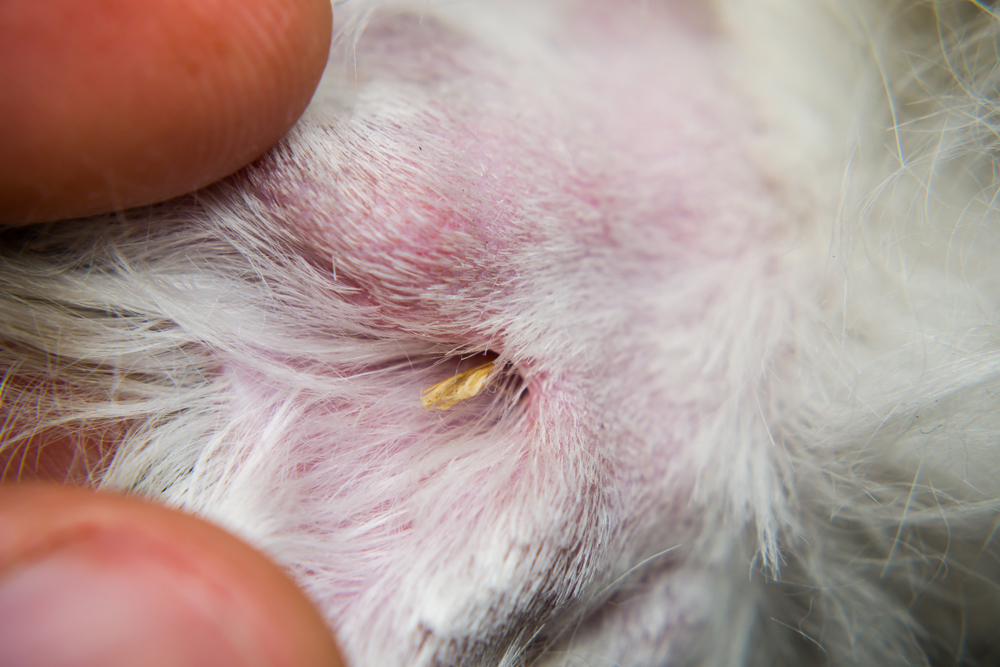
Foxtails and other grass awns are built like tiny barbed arrows. The seed head is shaped so it moves in one direction only, which means once it enters tissue it keeps traveling inward and cannot back out. It doesn’t dissolve, and the body can’t break it down, so it drags bacteria along a migrating path and leaves a trail of infection behind it.
Common entry points are between the toes, inside the ears and nose, under the eyelids, and anywhere the coat traps debris. A foxtail between the toes produces a swollen, draining spot that seems to improve on antibiotics and then comes right back, which is the classic tell. Nasal foxtails cause violent, sudden sneezing. Ear foxtails cause frantic head shaking and crying.
This is the category where antibiotics alone reliably fail. The infection returns every time because the object is still in there. Finding it is the whole job, and depending on where it went that may mean sedation and careful exploration, imaging, otoscopy to look inside the ear canal, or rhinoscopy to see up the nose. Around Reno, the dry grass season runs long, and dogs who hike or run in open fields are the usual patients.
Could a Fungal Infection Look Like an Abscess?
It can, and this one is worth knowing about in the Southwest. Valley Fever is caused by a fungus living in desert soil that a dog inhales when dust gets stirred up. Most of the time it stays in the lungs, but it can spread through the body and produce firm swellings, draining tracts, and non-healing sores in the skin and over the bones that look convincingly like bacterial abscesses.
Telling them apart matters enormously, because the treatments have nothing in common. Valley Fever treatment means months of antifungal medication, sometimes a year or more, and draining the lesion and prescribing antibiotics accomplishes nothing. Diagnosis usually combines bloodwork, a specific antibody test, chest imaging, and sampling of the lesion itself.
Northern Nevada sits at the edge of the range rather than the center of it, so travel history matters. A dog who has spent time in southern Arizona, southern Nevada, or California’s Central Valley belongs in this conversation even if the swelling appeared months later.
How Are Abscesses Treated?
Every abscess plan rests on the same three principles: open and drain the pocket, remove or address whatever caused it, and support the body with antibiotics and pain control while it heals. Skip any one of those and the abscess tends to come back.
Drainage is the part that provides immediate relief. Under sedation or anesthesia, the pocket is opened, flushed thoroughly, and any dead tissue is trimmed away. Larger abscesses sometimes get a soft drain placed for a few days so fluid keeps moving out rather than re-accumulating. Pain management is part of every single plan, because these are genuinely painful and a comfortable patient heals better.
| Severity | What treatment usually looks like |
| Small and superficial | Sedation, lancing, flushing, oral antibiotics and pain medication at home |
| Larger or deeper | Anesthesia, surgical opening and debridement, a drain, sometimes culture to target antibiotics |
| Foreign body involved | Locating and removing the object, often with imaging or scoping, plus wound care |
| Fungal | Antifungal medication for months, guided by testing rather than drainage |
| Systemically ill | IV fluids and antibiotics, hospitalization, and transfer to a 24-hour facility if overnight care is needed |
That last row matters for knowing where we fit. Peak Pet Urgent Care handles urgent problems rather than critical ones, and what urgent care covers has real edges. Most abscesses land comfortably inside them. A pet who is septic and needs overnight intensive support does not, and in that case we stabilize what we can and coordinate the transfer.
Frequently Asked Questions About Abscesses in Pets
My pet’s abscess already burst. Do we still need to come in?
Yes. A ruptured abscess has relieved some pressure, which is why your pet may seem more comfortable, but the pocket is still lined with infected tissue and the opening will often seal over and refill. It also still needs flushing, pain control, and usually antibiotics, and whatever caused it in the first place hasn’t gone anywhere.
Can I just put warm compresses on it and wait?
Warm compresses can help a developing abscess come to a head, and they’re a reasonable comfort measure while you’re arranging a visit. They are not a treatment. The pocket still needs to be opened and flushed properly, and waiting gives the infection more time to spread into surrounding tissue or the bloodstream. Never try to squeeze or lance one at home.
Why did my pet’s abscess come back after antibiotics?
Almost always because something is still in there. A retained foxtail, a splinter, an infected tooth root, or a diseased anal gland will keep reseeding the same spot no matter how many rounds of antibiotics your pet finishes. A recurring abscess in the same location is a signal to go looking for the cause rather than to try a different drug.
Found a Lump? Sooner Is Easier Than Later
Abscesses are painful, they rarely resolve without help, and they get harder to treat the longer they sit. The good news is that they’re also one of the most fixable problems we see, and most pets feel dramatically better within a day of having one properly drained. If you’ve found a swelling, your pet is licking obsessively at one spot, or something has already opened and started draining, walk in during our open hours or reach out to Peak Pet Urgent Care in Reno and we’ll get them comfortable. If your pet is severely ill and we’re closed, please head straight to your nearest 24-hour veterinary ER.



Leave A Comment