A pet in full noise panic is not just scared, they are dangerous to themselves. Dogs chew and claw through door frames until splinters lodge in their paws and gums, shred couches and swallow the stuffing, bolt through gates into traffic, or wedge themselves somewhere they cannot get out of. Cats disappear into walls and cabinets, stop eating, and can even develop urinary blockages from stress. These are not rare worst cases, they are the routine reasons a terrified pet ends up needing same-day care after a thunderstorm or a fireworks night.
Peak Pet Urgent Care in Reno sees the aftermath of that panic regularly, from lacerations and swallowed objects to pets hit by cars after escaping a yard. As a walk-in, triage-based urgent care practice, we can see these cases the same day, get your pet stable and comfortable, then send a full summary to your family veterinarian so the longer-term behavioral plan stays coordinated. If your dog or cat has hurt itself during a storm or a bout of panic, reach out to us and come in.
The Short Version Before the Next Storm
- Noise phobia is an extreme, persistent fear that goes far beyond the actual threat, and the danger is rarely the sound itself, it is what a panicking pet does to escape it.
- The common injuries follow the behavior: splinters and lacerations from chewing through doors, swallowed foreign bodies from destroyed furniture, and trauma from bolting into traffic.
- Panic hits the gut and bladder too, causing stress colitis in dogs, urinary blockage in male cats, and a dangerous liver condition in cats who hide and stop eating.
- Preventing all of it comes down to a layered plan: a secure retreat, everyday enrichment, patient desensitization, and sometimes medication prescribed by a veterinarian.
What Is Noise Phobia, and Why Does It Get Worse?
Noise phobia is an intense, lasting fear of sound that goes far beyond what the situation calls for. A confident pet hears the smoke alarm chirp, jumps, and moves on. A phobic pet hears it and cannot come back down, hiding, shaking, or clawing at a door for an hour after the noise has stopped.
Fear this out of proportion sits among the behavioral problems in dogs that trace back to genetics, breed predisposition, and life stage, and medical conditions like neurologic disease or pain can contribute too. Ruling out a medical driver is genuinely part of the picture, which is why our in-house lab work and imaging help sort out whether underlying disease is quietly turning up the volume on your pet’s fear.
Phobia also does something ordinary fear does not: it steals the recovery. Normal fear spikes and fades, but phobia lingers and often worsens with each exposure. It travels in company, too, since many noise-phobic pets carry separation anxiety or a more generalized anxiety alongside it.
What Sounds Set Pets Off Besides Fireworks?
Almost any sound can become a trigger, because a dog or cat hears a world we barely register. Frequencies we cannot detect, volumes that feel sharp to sensitive ears, and sudden onsets all make ordinary noises feel threatening. Fireworks get the headlines, but the everyday soundtrack of a home is often the bigger, quieter problem.
What Makes Thunderstorm Phobia So Hard to Treat?
A thunderstorm is not one scary sound. It is a whole event arriving at once: thunder, lightning, drumming rain, wind, a drop in barometric pressure, static, even the smell of rain rolling in. Many dogs react well before the first clap, pacing or hiding while the sky still looks clear, because they are reading the pressure and the air.
Sound recordings cannot recreate the flashes, the pressure, and the smell, so the usual training shortcuts only go so far. Storm fear also compounds, and a rough season can leave a pet more sensitive the following spring. Northern Nevada gets fewer storms than the Midwest, but our summer monsoon bursts are still plenty for a sound-sensitive pet.
Which Everyday Sounds Cause the Most Trouble?
The ordinary machines that run a household are a surprisingly common source of fear. Reading your dog’s body language means catching the lip licks, tucked tail, and sudden freeze that show a vacuum is becoming a genuine threat in your pet’s mind. Cats do this too, slipping away the second the dishwasher clicks on.
| Household trigger | Why it unsettles pets |
| Vacuum cleaner | Loud, unpredictable, and it moves toward them |
| Dishwasher, blender, garbage disposal | Sudden grinding or rushing sounds from the kitchen |
| Smoke and CO detectors | Sharp, high beeps that pierce sensitive ears |
| Doorbells | Paired with strangers arriving, so fear plus arousal |
| Alarm clocks | A jarring start that repeats at the same time daily |
How Bad Is My Pet’s Reaction?
Noise phobia runs on a spectrum, from a pet who looks unsettled to one in true panic risking injury. The table below helps you place where your pet falls and how urgently to act.
| Severity | What you might see |
| Mild | Alertness, mild restlessness, a little pacing, ears pinned |
| Moderate | Trembling, hiding, heavy panting, drooling, whining or howling, clinging to you |
| Severe | Destructive chewing or digging, frantic escape attempts, self-injury, loss of bladder or bowel control |
Rising fear climbs a predictable stress ladder, from a subtle turn of the head to full-blown panic, and spotting the lower rungs keeps a mild sensitivity from hardening into a phobia. Escape attempts and self-injury are the behaviors that fill our exam rooms after a loud night, and left unaddressed, months of panic take a real toll on quality of life.
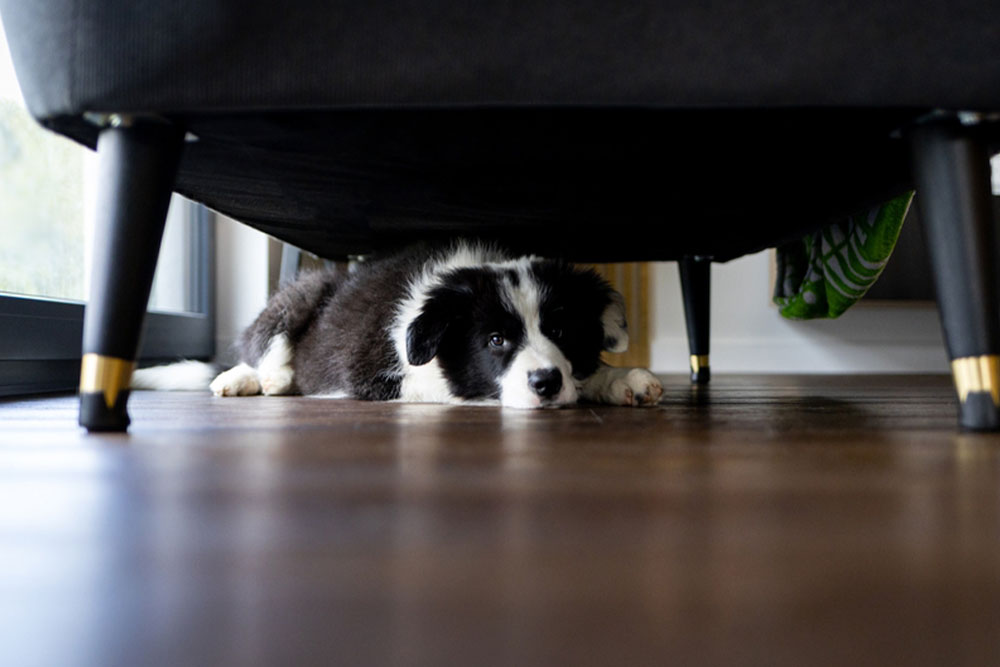
What Injuries Do We Actually See After a Storm or Fireworks?
The injuries follow the behavior. A panicking pet is trying to escape a sound they cannot escape, and stress can cause internal organ changes. Most are treatable, and most are far easier to treat early.
Chewing and Clawing Through Doors, Windows, and Crates
A dog trying to dig through a door frame or window sill does real damage to their own mouth and feet. We pull wood splinters out of paw pads and lodged along the gums, treat torn and avulsed nails that bled all night, and repair the deep cuts that come from metal crate wire and broken glass. Teeth get fractured on crate bars, and pads get sliced open on the way through a screen door.
Destroyed Furniture and Swallowed Objects
A shredded couch is an expensive problem right up until it becomes a medical one. Dogs who tear into cushions during a panic frequently swallow what they pull out, and stuffing, foam, and upholstery fabric are all classic causes of intestinal obstruction. The tricky part is timing: a pet may seem fine for a day or two before vomiting starts, so the couch you found destroyed on Saturday can become an emergency on Monday. When something is stuck, foreign body retrieval may be possible without an incision through endoscopy, though an object that has moved further along can require abdominal surgery. Peak Pet Urgent care offers both in our Reno hospital.
The Pet Who Gets Out
Escape is the one that frightens us most. A dog who clears a gate or slips a collar during fireworks is loose in traffic, often at night, often running blind with panic. Pets hit by cars arrive with the full range of blunt trauma, and orthopedic damage like a pelvic fracture is among the most common results. A pet who stays lost for hours faces a second problem on top of any injury, since dehydration sets in quickly in the high desert heat, especially in a dog who has been running. Any pet who has been struck by a car should be seen even if they get up and walk, because internal bleeding and chest injuries hide well behind an animal who looks shaken but stable.
When Panic Lands in the Gut and Bladder
Stress does not stay in the head, and this is where cats in particular get into trouble. In dogs, a hard fright often shows up a day later as stress colitis, with straining, mucus, and streaks of fresh blood in loose stool, uncomfortable but usually very manageable once we get your dog started on treatment.
Cats face two more serious risks. Stress is a well-established trigger for feline idiopathic cystitis, and in male cats that inflammation can progress to a complete urethral obstruction, which is life-threatening within a day. A male cat straining in the litter box, crying, or producing nothing at all is an emergency, not a wait-and-see. The other risk builds more slowly: a frightened cat who hides and refuses food for even a couple of days can develop hepatic lipidosis, a dangerous liver condition that arrives precisely because they stopped eating. If your cat has not eaten since the fireworks, that is reason enough to come in.
Hiding creates its own injuries. Cats squeeze into wall cavities, drop into ceiling spaces, and wedge behind cabinets and appliances, where they can be trapped for hours, overheat, or get cut on the way in or out. Before a loud event, closing off crawl spaces and blocking gaps behind appliances is a key part of injury prevention.
How Do I Create a Safe Space for a Noise-Phobic Pet?
The single most useful thing you can build is a retreat: a quiet, enclosed spot your pet already trusts, prepared before the noise starts rather than during it. A retreat only works if it is genuinely safe, so pet-proofing your home around the chosen room means removing the cords, chemicals, and breakables a panicked pet could turn on.
- Pick an interior room: A bathroom, closet, or windowless space muffles sound and hides the lightning flashes.
- Close curtains and blinds: Blocking the visual jolts takes one whole layer off a storm.
- Add sound cover: White noise, a fan, or calming music masks the peaks of thunder and appliance noise.
- Bring familiar comfort: Their own bed and a blanket that smells like home settle the nerves.
- Offer a distraction: A stuffed puzzle feeder or a favorite chew gives busy paws somewhere to go.
- Stay calm yourself: Pets read our tension, so a relaxed voice and easy body language help more than fussing.
One worry we hear constantly: does comforting a scared pet reward the fear? It does not. Fear is an emotion, not a trained trick, and you cannot reinforce an emotion with kindness. If sitting quietly beside your dog helps him breathe easier, do it.
How Does Enrichment Help a Pet Handle Stress?
Confidence is built on ordinary days, not during the storm. Regular enrichment builds the resilience that helps a pet weather stress instead of unraveling at the first loud noise. Scent games, food puzzles, and short training sessions are all enrichment activities that lower baseline anxiety long before the next thunderstorm. Cats want this too: a foraging toy, a window perch, and a few minutes of wand play go a long way.
Can Training Actually Fix a Noise Phobia?
Behavior modification is the backbone of lasting change, and it works best during calm stretches rather than mid-panic, ideally with professional guidance shaping the plan. You are not forcing your pet through the fear, you are rewriting what the sound means to them.
How Do Desensitization and Counterconditioning Work?
Systematic desensitization means playing a trigger sound at a volume so low it barely registers, then pairing it with something wonderful, treats, a favorite game, warm praise, so the sound starts to predict good things instead of danger. Over many short sessions, you nudge the volume up only as your pet stays relaxed. It works beautifully for predictable, recordable sounds like a vacuum or a doorbell, and much less well for a thunderstorm a recording can never fully capture. Expect weeks to months, and back off the moment your pet shows stress.
Why Does Positive Reinforcement Beat Punishment Every Time?
Reward-based positive training gives your pet a job instead of a fear to sit in, teaching them to head to a safe spot or settle on cue. You can teach a dog to run to his mat when the doorbell rings, or a cat to hop onto a favorite perch, and reward that choice until it becomes automatic.
Punishment backfires hard. Scolding a frightened pet adds a new fear on top of the old one, teaches them to hide the early warning signs, and erodes their trust right when they need it most. There is no version of a noise-phobia plan where punishment belongs.
What Medications and Supplements Help With Noise Phobia?
Moderate to severe noise phobia often needs pharmacological help alongside the training and environment work, because a brain in full panic cannot learn. Medication is not a failure or a shortcut; it is often what finally lets everything else start working. Every option below should be prescribed and monitored by a veterinarian who knows your pet.
- Situational anti-anxiety medication: Given before a predictable event like a storm forecast, these ease the acute panic.
- Daily anxiety medication: For pets whose anxiety runs high year-round, a longer-acting daily medication can lower the baseline.
- Calming supplements: Certain proven supplements can take a gentle edge off milder cases.
- Pheromone diffusers: Species-specific calming pheromones can make a room feel safer.
- Pressure wraps: Snug body wraps provide steady, comforting pressure for some pets.
The real power is in the combination, and these work best layered together rather than tried one at a time.
Where Does Urgent Care Fit In?
Your family veterinarian owns the long-term behavioral plan. We cover the gaps, and as a walk-in urgent care we are the space between your regular vet and the ER. When panic turns into an injury, your pet can be seen promptly for urgent care in Reno, and we coordinate back with your regular veterinarian so nothing falls through.
Frequently Asked Questions About Noise Phobia in Pets
My pet seems fine after the storm. Do I still need to have them checked?
Sometimes, yes, and it depends on what they did. A pet who trembled through it and recovered is fine to watch at home. A pet who chewed at a door, destroyed something they might have swallowed, got outside, or has not eaten since needs eyes on them, because splinters, foreign bodies, and internal injuries all hide well behind a pet who is walking around normally the next morning.
Will my pet grow out of a noise phobia on their own?
Rarely. Left alone, noise phobia usually holds steady or worsens with each frightening exposure. The good news is that it responds well to a thoughtful plan, and the earlier you start, the easier the path, so a mild sensitivity you notice now is worth acting on rather than waiting.
Is it safe to give my dog human anti-anxiety medication during a storm?
Human anti-anxiety and sedative medications can be dangerous or even toxic for pets, and the dosing is completely different. Some worsen anxiety or leave a pet sedated but still terrified underneath. There are veterinary medications made specifically for noise events, and they should always be prescribed by your veterinarian. If your pet is panicking and you are worried about an injury, come in and let us help rather than reaching for something from your own cabinet.
Helping Your Pet Find Calm When the World Gets Loud
Living with a noise-phobic pet is genuinely hard, especially watching them shake through a storm you cannot make stop. The fear is manageable with patience and a good plan, and the injuries it causes are treatable when they are caught early rather than waited out.
If panic has already led to a cut, a torn nail, a swallowed object, or a cat who has stopped eating, our team provides urgent care for cats and dogs the same day. You can come in as a walk-in whenever your pet needs us.