

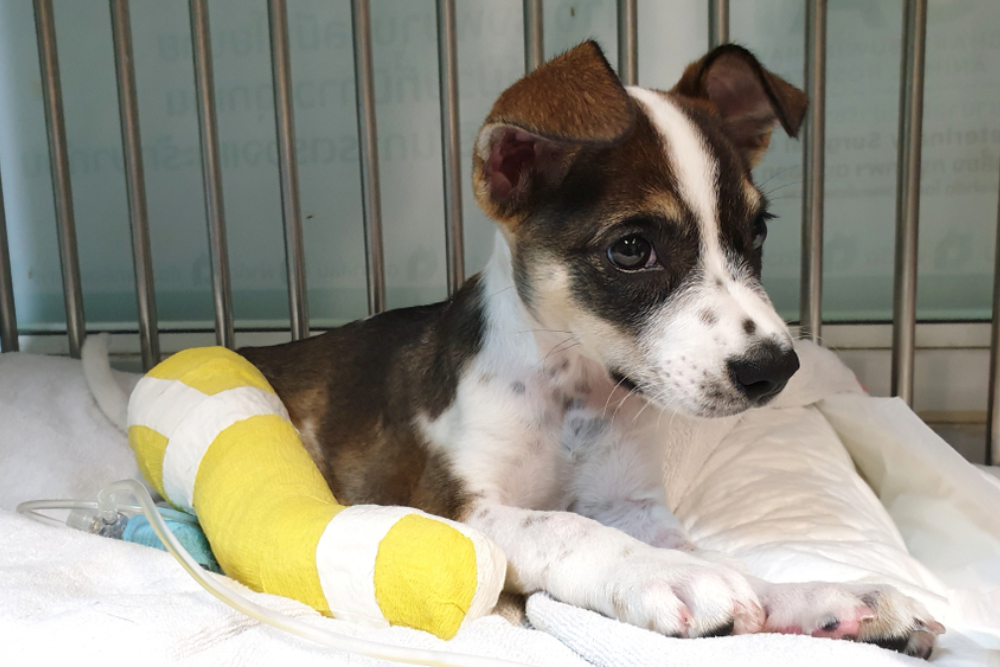
Most broken bones are urgent care territory rather than a 24-hour emergency hospital, because a fracture, while painful and frightening, is rarely immediately life-threatening. When your dog or cat is suddenly not bearing weight on a limb, the question of where to go can feel as urgent as the injury itself, and knowing the answer ahead of time saves you a stressful guess. The right setting gets your pet treated faster, with less wait time and a bill that reflects the level of care actually needed without the 24/7 ER charges.
Peak Pet Urgent Care in Reno is built precisely for moments like this. We handle long bone and pelvic fracture repair in-house, along with digital radiography to confirm the injury and guide the treatment plan. As a walk-in, triage-based clinic, we see the sickest pets first, and fractures get the prompt attention they need. Give us a call or come in, and we’ll take it from there.
Quick Reference: Fractures and Where to Go
- Most fractures are urgent care, not emergency: pain and swelling without breathing difficulty, severe blood loss, or shock can usually be managed at an urgent care facility.
- Trauma changes the answer: a fracture with associated trauma (hit by car, fall from height) often needs full emergency evaluation first to rule out internal injuries.
- Stabilize conservatively before transport: do not try to set the bone yourself.
- Urgent care is usually faster and cheaper: wait times are typically shorter than at 24-hour emergency hospitals, and the cost is often lower for the same care.
Why Are Most Fractures Urgent Care Cases?
A broken bone in dogs or cats is painful and visibly alarming, but it’s rarely a true emergency. The body’s vital systems usually aren’t immediately threatened. What needs to happen quickly is pain control, imaging to characterize the fracture, stabilization, and a treatment plan, all of which urgent care facilities like ours are equipped to handle. The distinction matters because:
- Wait times are typically shorter: emergency hospitals see the sickest cases first, which can mean hours of waiting for a non-critical fracture.
- Cost is often lower: urgent care overhead is less than 24-hour emergency staffing.
- Treatment quality is equivalent for fractures that don’t involve other life-threatening injuries.
- Care coordination is simpler: your regular veterinarian gets the records easily.
When Is the ER the Right Choice?
The ER becomes the right call the moment a fracture stops being just a fracture. If your pet has been through major trauma, is losing significant blood, is struggling to breathe, or seems to be crashing, those problems outrank the broken bone and need a 24-hour critical care team first. Head to a 24-hour emergency facility instead if:
- Your pet was hit by a car or fell from significant height (internal injuries possible).
- There’s significant blood loss that isn’t controlled.
- Breathing is labored or there are signs of chest trauma.
- Your pet is unresponsive, in shock, or rapidly deteriorating.
- The fracture is compound (bone protruding through skin) with active heavy bleeding.
- Multiple body systems appear affected (a limb injury plus abdominal swelling, for example).
- We’re closed for the day (we’re not 24/7).
For these scenarios, time matters more than facility type. Get to the nearest 24-hour emergency facility immediately.
What Are the Signs of a Fracture?
Most fractures announce themselves clearly: a sudden limp, a refusal to put any weight on the leg, swelling, and sometimes a limb that looks bent or shortened. Pain is usually obvious. Not every break is dramatic, though, and a few types are easy to mistake for a simple sprain, which is exactly where imaging earns its keep. Not every fracture happens in a leg, either. The less visible ones include:
- Toe fractures can be subtle, with intermittent lameness.
- Pelvic fractures may not show obvious deformity but cause severe pain.
- Mandibular (jaw) fractures may appear as inability to close the mouth or a lack of appetite.
- Greenstick fractures in young animals (incomplete fractures) can produce limping without obvious swelling.
- Spinal compression fractures may show as weakness or wobbliness rather than localized pain.
- Pathologic fractures appear as sudden limping and occur when bone weakens from disease, like osteosarcoma (bone cancer).
If you’re not sure whether the injury is a fracture or a soft tissue injury, imaging is what answers the question.
What Should I Do Before Heading In?
The goal before you leave the house is simple: keep your pet still, keep yourself safe, and avoid making the injury worse. You don’t need to fix anything, you just need to get your pet to us comfortably and in one careful piece. A few steps make the trip safer for both of you:
- Keep your pet as still as possible. Movement worsens pain and can shift bone fragments.
- Don’t try to set the bone or apply pressure to a deformed limb. Leave the limb in whatever position is least painful.
- For open fractures with bleeding, apply gentle pressure with a clean cloth or gauze. Don’t try to push protruding bone back in.
- For pets able to walk on three legs, let them move on their own. Don’t pick them up if they can self-transport.
- For small dogs and cats, lift carefully supporting the body, not the affected limb.
- For large dogs unable to walk, use a sturdy board, sled, or blanket carried by two people as an improvised stretcher.
- Apply a muzzle if needed. Even gentle pets bite when in severe pain; improvise with a leash, a towel loosely draped over their head, or soft cloth around the snout if necessary.
- Call ahead so we can prepare. Our triage-based system means letting us know what’s coming helps everything move faster.
Don’t give human pain medications. NSAIDs that are safe for humans can be toxic to pets, and even pet-safe medications need professional dosing.
What Happens When You Arrive?
Once you’re here, care follows a clear, fast sequence built to get your pet comfortable and onto the right plan as quickly as possible. The exact path depends on the fracture and your pet’s overall condition, but most visits move through the same steps:
- Triage. We assess severity and prioritize care.
- Pain control. Appropriate medications administered as quickly as possible.
- Imaging. Digital radiography to characterize the fracture: which bone, where, how complete, whether the joint is involved, whether bone fragments are displaced. Pets usually need to be sedated or anesthetized for this, since we’ll be moving their painful body part and they need to stay perfectly still.
- Stabilization. A splint, bandage, or sometimes immediate surgical planning depending on the fracture.
- Treatment plan discussion. What the fracture needs, what the recovery looks like, what it will cost, and what the realistic outcomes are.
Some fractures can be managed conservatively with a splint or bandage. Many require surgical fracture repair. Some are so severe they require amputation. We’ll go over the options with you in detail.
Which Fractures Can Be Treated Without Surgery?
Plenty of broken bones heal well in a cast or splint, no surgery required. Conservative management tends to work when a fracture is stable and well aligned, sits low on a limb where a splint can immobilize the joints above and below it, or occurs in a young animal whose bones are still growing and knit quickly. Imaging is what tells us which camp a fracture falls into.
The fractures that often do well without surgery include:
- Stable, well-aligned fractures of the lower front or hind limb, where the bone ends have not shifted out of place.
- Greenstick and other incomplete fractures in puppies and kittens, whose bones heal faster than an adult’s.
- Some toe, foot, and lower-leg fractures that can be fully immobilized in a splint or cast.
- Cases where surgery carries extra risk, such as certain medical conditions, where a non-surgical approach is the safer trade.
A splint or cast works by holding the limb completely still so the bone ends stay together and knit. That only works when the break is stable to begin with, which is why some fractures still need surgery: displaced or shattered (comminuted) breaks, fractures that involve a joint, and breaks high on the leg in the femur or humerus, where a cast cannot reach far enough up the limb to hold things still. Even a fracture treated without surgery needs recheck imaging along the way, because a splinted bone can still shift and a splint itself can loosen or fail. We’ll walk you through which path fits your pet, and what recovery looks like either way.
How Are Fractures Repaired Surgically?
Surgical repair realigns the broken bone and holds it steady while it heals, and the right method depends on the fracture pattern, the bone involved, and your pet’s size. Some breaks need surgery to heal correctly, while others do well with a splint, which is exactly what imaging helps us sort out. Our surgical capabilities handle several fracture types in-house:
- Long bone fracture repair for fractures of the femur, tibia, humerus, radius, and ulna.
- Pelvic fracture repair for displaced or unstable pelvic fractures.
- Femoral head ostectomy as an alternative for some hip injuries when total hip replacement or plating and pinning isn’t feasible.
Surgical fracture repair typically uses bone plates, screws, pins, or external fixation depending on the fracture pattern, bone, and patient size. We talk through the specific approach for your pet’s case before proceeding.
How Do I Care for My Pet’s Cast or Splint at Home?
A cast or splint only does its job if it stays clean, dry, and intact, which makes your at-home care a real part of the healing. The short version: keep it dry, check it daily, stop your pet from chewing it, and call us the moment something looks, smells, or feels off. Most splints also need scheduled rechecks and changes as the limb heals.
A few habits keep a splint working the way it should:
- Keep it completely dry. Moisture trapped under a cast quickly leads to sores and infection. Cover it with a plastic bag for bathroom trips and take the bag off as soon as you are back inside, since leaving it on traps humidity too.
- Check the exposed toes daily. The two middle toes are usually left peeking out for a reason. Swelling, toes spreading apart, a cool feel, or a color change can signal that the bandage is too tight or circulation is affected, and that needs same-day attention.
- Inspect the edges and surface. Look for rubbing or sores where the cast meets skin, any wetness or staining, a slipped or loosening fit, or a foul smell, which often points to a sore or infection underneath.
- Stop the chewing and licking. Keep the e-collar (cone) on consistently. A pet who chews through a splint can undo the repair and injure the limb, and sudden chewing is sometimes the first clue that something underneath hurts.
- Restrict activity. Strict rest, leash-only bathroom breaks, and no running, jumping, or stairs. A splint is not built to survive a zoomie.
Call us right away, or reach out to our team, if you notice swollen, cold, or discolored toes, a bad smell or discharge, a splint that is wet, slipped, or damaged, sores at the edges, or a pet who suddenly will not settle, stops eating, or seems painful. Casts and splints also need to be changed and rechecked on a schedule we set with you, so the limb gets reassessed and the bandage stays clean and correctly fitted as swelling goes down.
What Does Recovery After Fracture Repair Involve?
Crate rest is a major part of fracture recovery. Bones take 8 to 12 weeks to heal fully in adult dogs and cats, longer in some cases, and recovery moves through predictable stages:
| Recovery phase | Timeframe | Focus |
| Strict confinement | Weeks 1 to 4 | Crate rest with minimal movement |
| Controlled activity | Weeks 4 to 8 | Gradually increasing, leash-only movement |
| Recheck imaging | Weeks 4 to 6 | Confirm healing progress |
| Full healing | 8 to 12 weeks in adults | Longer in some cases |
A few practical considerations smooth the process:
- Mental enrichment during confinement matters. DIY cognitive dog toys and other enrichment ideas provide mental stimulation without physical exertion.
- Sedation may help for high-energy dogs who can’t tolerate confinement.
- Recheck imaging at 4 to 6 weeks confirms healing progress.
- Physical therapy in the later stages of recovery helps rebuild strength.
- Implant removal is sometimes needed after the bone has healed, depending on the hardware used.
Frequently Asked Questions About Fractures and Urgent Care
Can my pet die from a broken bone?
A fracture itself is rarely immediately fatal. The exceptions: severe open fractures with massive blood loss, spinal fractures causing respiratory paralysis, or fractures that are part of a larger trauma involving internal injuries. For most fractures, the pet is in pain but not immediately at risk of dying, which is why urgent care is the right setting for most cases.
How much does fracture repair typically cost?
It varies considerably by fracture type, surgical approach, and individual circumstances. We discuss estimates before treatment proceeds, and we offer Cherry payment plans for spreading costs. Urgent care fracture repair is typically less expensive than emergency hospital fracture repair for equivalent care.
What if my pet’s fracture happens after hours?
Outside our normal hours, the nearest 24-hour emergency hospital is the right call. Initial pain control and stabilization can happen there, with follow-up surgical repair coordinated with us or with your regular veterinarian.
Do you treat fractures in cats?
We do. Our surgical services for pets in Reno include fracture management for cats as well as dogs, with cat-appropriate handling and species-specific techniques.
What should I do if my pet’s cast or splint gets wet or slips?
Call us and bring your pet in to have it checked or replaced. A wet cast holds moisture against the skin and can cause sores or infection within a day, and a slipped splint is no longer immobilizing the break the way it needs to. Don’t try to dry it out, re-wrap it, or push it back into place yourself; a quick bandage change at our clinic is far safer than a splint that is doing more harm than good.
Knowing Where to Go Before You Need To
The middle of an injury isn’t the right time to research veterinary options. Knowing where to go for which kind of situation, and having our number saved for the moments you need it, makes a real difference.
If your dog or cat in Reno has a broken bone or limp, walk in or contact us to talk through the situation, and we’ll work fast to treat the pain and get them on the road to recovery.



Leave A Comment